


Workplace culture design starts long before a values statement appears on a wall. It starts with how people move through a space, where they pause, who they see and how often informal contact happens.
Think back to the first friends you made. School, most likely. University. Those early jobs. Places you did not choose so much as land in.
What those places had in common was not that everyone was especially warm or socially gifted. They were structured around repeated, low-stakes contact. The same building, the same people, again and again, with reasons to interact.
Names had to be exchanged. You had to make something, build something, solve something, then do it again the next day. Many close friendships form that way. The ones that follow you out of the building often start with simple proximity.
Why workplace culture design starts with repeated contact
The workplace still plays a powerful role in how people connect. Research reported by HR Grapevine found that 21% of Brits met their closest friends at work. Gallup has also linked having a best friend at work with stronger engagement, performance, innovation and retention.
Most organisations understand this in theory. They read the research, nod at the findings and then move back to the usual language of collaboration, utilisation and productivity.
However, culture is not only shaped by policies or leadership messages. It is shaped by the daily conditions that make trust easier to build. Familiarity creates comfort. Comfort creates trust. Over time, trust can become friendship.
Why connection has become harder at work
We often assume friendship is organic. Hire decent people and the rest will sort itself out. That assumption ignores the conditions that made connection possible in the first place.
Remote and hybrid working have made this more complicated. Many people now communicate through Teams, Slack or email for most of the week. These tools are useful, but they can also become noise rather than connection.
Some people view work as transactional. Others prefer to keep their personal lives separate. There is nothing wrong with that. However, it means that when people do come into the office, the environment needs to work harder.
This is where workplace strategy becomes important. A good brief should not only ask how many desks are needed. It should also ask how people meet, move, pause, share knowledge and build trust.
The office as infrastructure for accidental connection
The office used to create connection almost by accident. Shared kitchens, corridors, staircases, print points and reception areas brought people together without anyone needing to schedule it.
Then many offices became more efficient. Departments were separated. People were given their own zones, their own meeting rooms and their own facilities. In the process, some workplaces removed the very conditions that made informal connection possible.
A floor plan can either help people find each other or make that harder. It can encourage movement across teams, or it can let people arrive, sit, work and leave without speaking to anyone outside their immediate group.
That is why workplace culture design should be considered at the earliest stage of planning. Culture is not simply something that happens inside a space. It is influenced by the space itself.
Floor plan decisions that shape workplace culture design
Designing for connection does not mean forcing people into constant interaction. It means creating moments where contact can happen naturally.
- Shared amenities should pull people together rather than keep them in separate corners of the office.
- Central social spaces should feel different from formal work areas, so people feel able to pause and relax.
- Circulation routes should connect teams rather than route people around them.
- Linger spaces should give people a reason to stay for a few minutes without needing a meeting.
- Clear sightlines can keep people visible to each other without making the office feel exposed or crowded.
These are small decisions, but they shape behaviour. Over time, they influence whether an office feels connected, fragmented, welcoming or difficult to use.
How this thinking shaped Eight Financial Advice
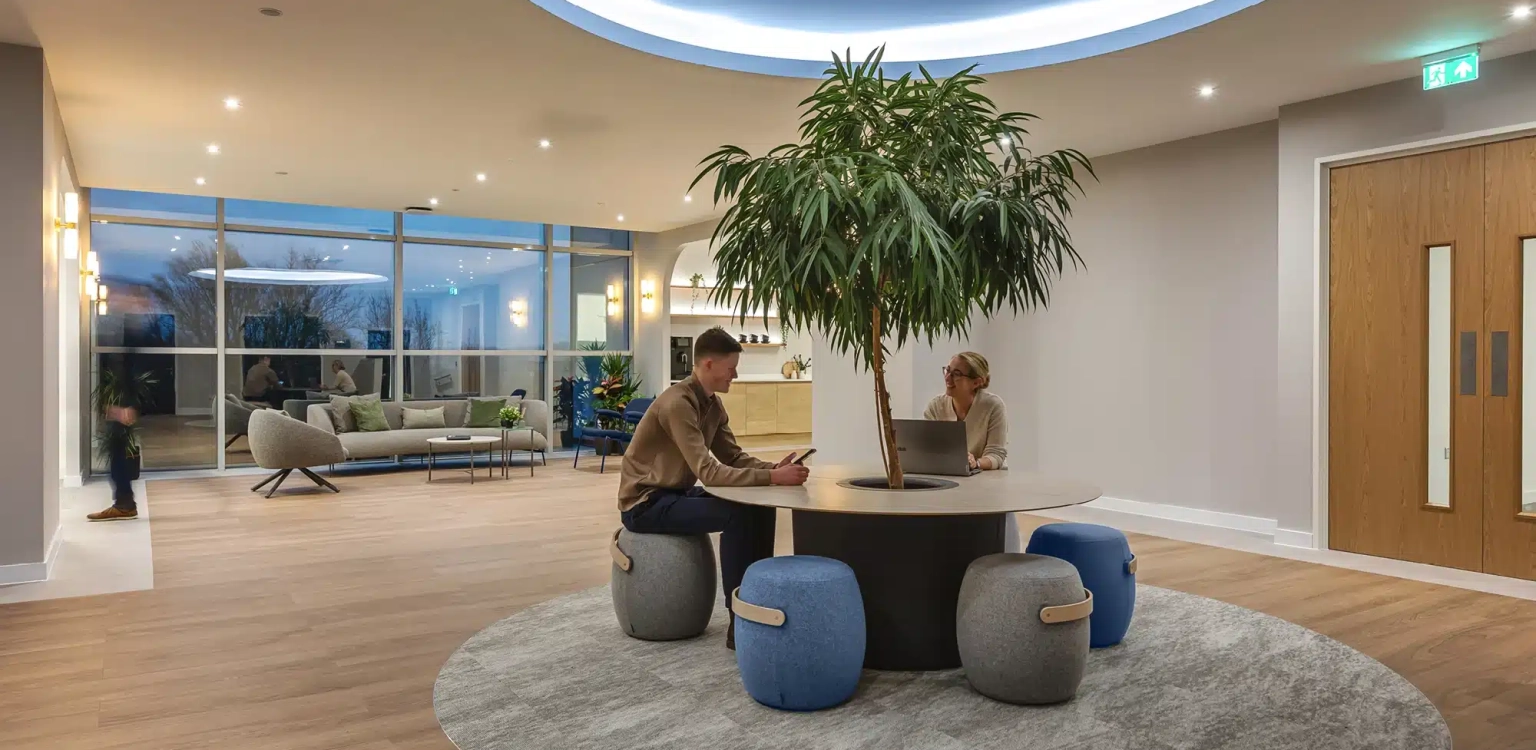
When Eight Financial Advice came to Spectrum for its new headquarters, the brief centred on client experience and a professional working environment. Those things mattered, and they needed to be delivered well.
As the design developed, another layer became clear. The layout needed to do more than impress visitors. It also needed to support the people using the space every day.
Alongside advisory offices and client-facing areas, the completed Eight Financial Advice headquarters includes breakout areas, collaborative zones and informal meeting spaces. These are not just visual features. They create opportunities for interaction that are not attached to a formal agenda.
That is where culture often lives. Not only in the boardroom or the team meeting, but in the quieter moments that help people become familiar with each other over weeks and months.
What this means in practice
If you are reviewing your workplace, planning an office relocation or trying to understand why a recent change did not land, ask one simple question:
Is this office designed to help people find each other?
Not in a forced or organised way. Nobody wants friendship scheduled into their calendar. The question is subtler than that.
- Are there spaces people naturally drift towards?
- Do routes mix teams or keep them apart?
- Are shared areas easy to reach, visible and comfortable?
- Does the space support both planned collaboration and informal contact?
- Are people being helped to understand and use the space properly?
That final point matters. Workplace onboarding and integration can help teams understand how a new environment is intended to work, so the design does not rely on guesswork after handover.
Frequently Asked Questions
How do we know if our office layout is affecting workplace culture?
Watch how people move and mix. If teams rarely cross paths or shared areas sit empty, a workplace consultancy review can show whether the issue is layout, culture or both.
Do we need a full office redesign to improve culture?
Not always. Small changes to routes, shared spaces or furniture can help, but a wider office design review may be needed if the layout works against connection.
What types of spaces help people build stronger relationships at work?
Shared kitchens, visible breakout areas and quiet spaces help people connect. For wider thinking, see our sustainable office design and accessible workplace design guides.
Does workplace culture design still matter for hybrid teams?
Yes. A hybrid working office has fewer shared days, so it needs to make trust, collaboration and informal contact easier when people are together.
How do we make sure people use the spaces as intended?
Explain the purpose of each setting before and after launch. Workplace onboarding helps teams understand how to use the space with confidence.


